
free color analysis
Free Color Analysis
By the StyleCard Team · Last updated July 3, 2026
Compare free color analysis quizzes, AI photo tools, and StyleCard's free preview so you know what is useful before paying.
Short answer
A free color analysis can give you a likely color direction. The best free tools explain their limits, ask for a good photo, and give enough guidance to try colors in real life.
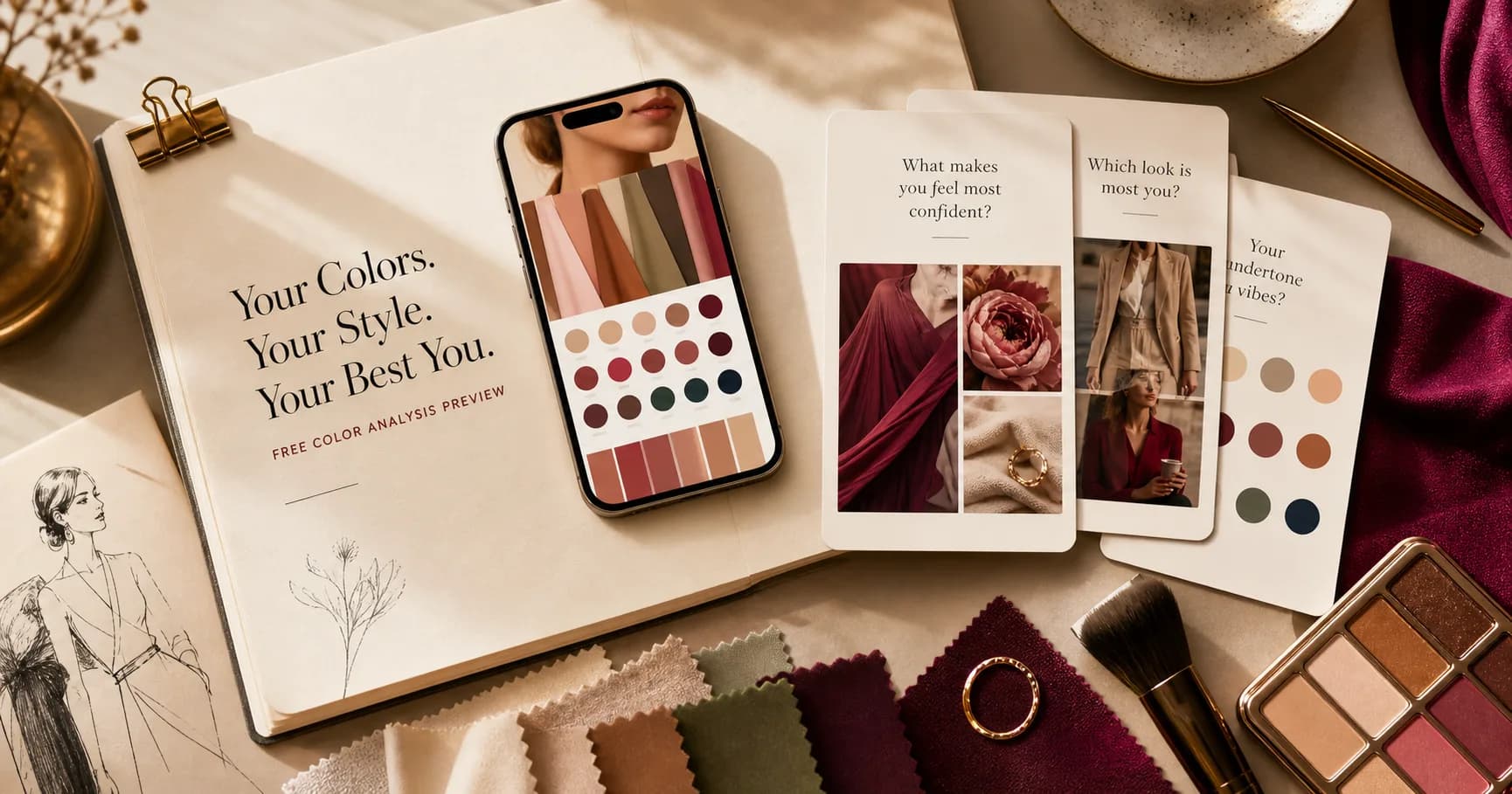
Free color analysis is worth trying if you treat it as a first pass. It can help you stop buying the same wrong colors, notice whether warm or cool shades suit you better, and build a short list of palettes to test.
The catch is that free tools vary a lot. Some are simple quizzes. Some use a selfie. Some give a season name but hide the useful styling advice behind a paywall. A good free result should be clear about what it can and cannot tell you.
What free tools usually include
Most free tools give you a seasonal label, a few best colors, and a short explanation of undertone or contrast. That is enough to test a palette in your closet, but not always enough to shop, choose makeup, or plan a hair change.
Watch for tools that call themselves free but ask for payment before showing anything useful. A preview should help you decide whether to continue, not trap you after you upload a photo.
The main free-method split is quiz, selfie analysis, AI prompt, and app preview. Each can be useful, but each fails differently. A quiz can miss mixed undertones. A selfie can be skewed by lighting. A prompt can sound confident with weak evidence. An app preview can be too thin if it only gives a label.
- Basic quiz: fast, but depends on self-reporting.
- Photo upload: more personal, but only if the photo is clear and unfiltered.
- AI styling app: often adds outfits, makeup, or hair direction.
- Professional consultation: more expensive, but can test drapes in controlled light.
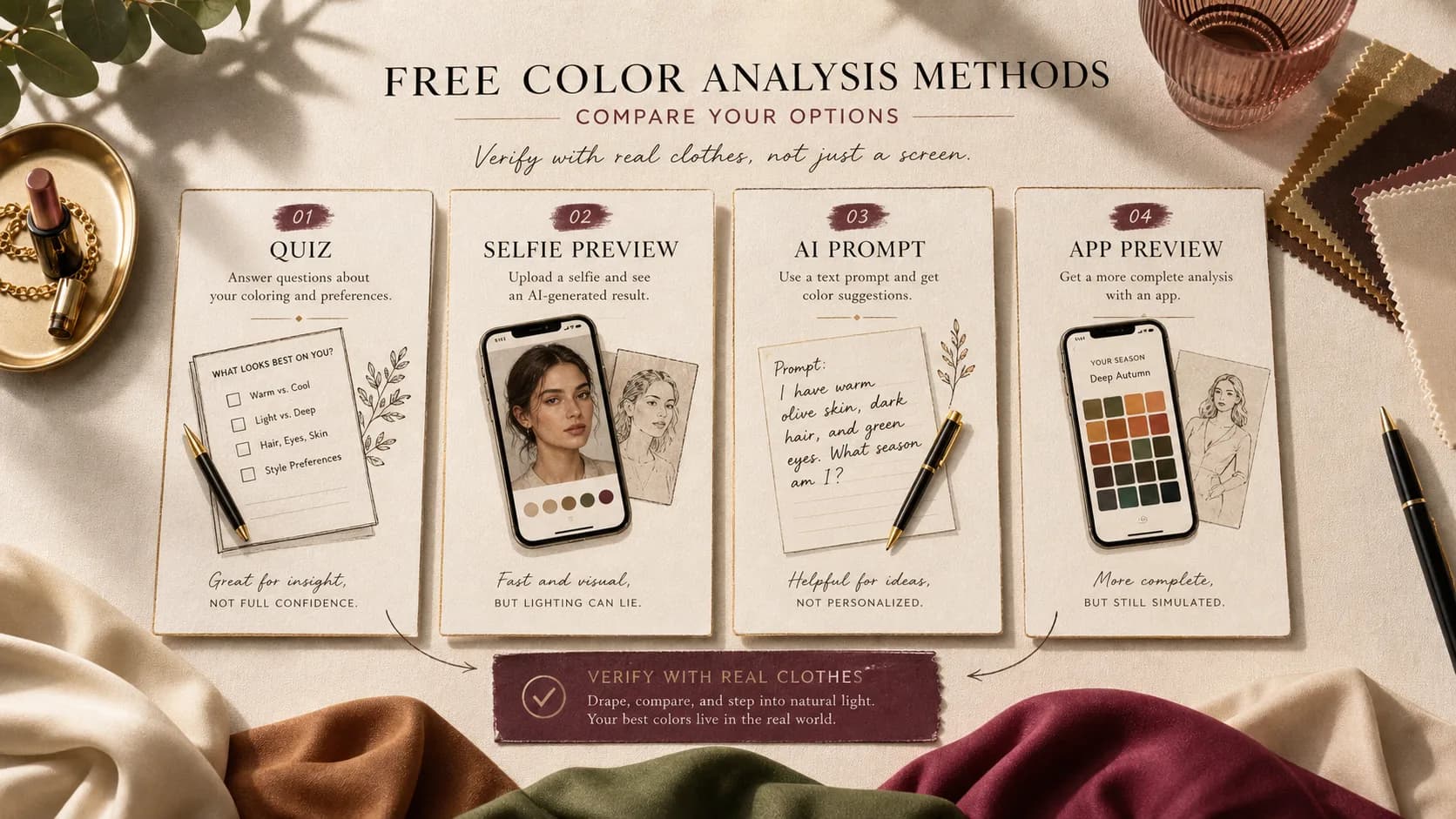
Free method comparison
Use a free quiz when you want language for what you already suspect. Use a free AI or selfie preview when you want to see how your face, contrast, and undertone work together. Use ChatGPT after you have a likely direction and need outfit or palette vocabulary. Use real fabric checks when you want to validate whether the result survives daylight.
The best free result is specific enough to test. It should name likely temperature, value, and chroma, give a few colors to try, name a few colors to avoid, and explain why the result might be uncertain.
- Strong free result: gives likely season, best colors, avoid colors, and photo-quality caveats.
- Weak free result: gives only a season name and no way to verify it.
- Strong next step: test three suggested colors and two avoid colors near your face in daylight.
- Weak next step: buying a new wardrobe before the palette proves itself.
What free analysis can and cannot tell you
Free analysis can usually answer one narrow question: which direction should you test first? It can tell you that warm clear colors are worth comparing with cool muted colors, or that black may be too heavy, or that your makeup probably needs cooler rose instead of peach.
It cannot reliably prove a lifelong 12-season label from one quiz or one selfie. It also cannot account for every product choice. Foundation, lipstick, hair color, glasses, jewelry, and wardrobe fabric all change the effect. That is why the most useful free result includes uncertainty and a verification plan.
- Useful free answer: likely warm/cool direction, likely soft/bright direction, colors to test, colors to avoid.
- Not enough: one season label with no lighting caveat, no photo instructions, and no real-world test.
- Upgrade trigger: you need makeup, hair, wardrobe, or shopping decisions, not just a color family.
- Privacy trigger: before uploading a face photo, check retention, deletion, training use, and whether the tool stores a full report.
Free vs paid upgrade checklist
Do not pay just because a page makes the free result feel incomplete. Pay when the extra output solves a specific problem: a saveable palette, outfit formulas, makeup colors, hair direction, shopping guidance, or a more careful explanation of uncertainty.
Free tools often use one of three models: genuinely free but shallow, free preview with a paid report, or free app with ads and premium features. None is automatically bad. The question is whether the free layer gives enough evidence for you to decide whether the paid layer is useful.
- Worth paying for: clear next steps, practical examples, visible privacy terms, and guidance beyond a season label.
- Use caution: recurring subscriptions, unclear deletion terms, overconfident accuracy claims, or no explanation of photo quality.
- Stay free: you only need a quick warm/cool gut check or want to learn the vocabulary before testing clothes.
- Choose a consultant: you have conflicting results, high-stakes purchases, complex coloring, or want real fabric draping.
What StyleCard's free preview includes
StyleCard gives you a free teaser result from your selfie and quiz answers. The preview is designed to be useful on its own: you get a direction for your colors and style before deciding whether to buy the full pack.
The full Style Card Pack costs $9.99 and includes five cards: color story, outfit direction, makeup direction, hair direction, and style overview. That upgrade is best if you want the result turned into something you can save, compare, and use while shopping.
When free is enough
Free is enough when you want a gut check. Maybe you suspect black looks too harsh, or you keep buying beige and never wearing it. A free preview can help you test a better lane before you spend money.
Upgrade when you need a more complete answer. If you want makeup shades, hair color direction, outfit examples, and a shareable visual card, a plain season label will feel thin.
Good free result vs weak free result
A good free color analysis result gives you something to test immediately. It should tell you likely temperature, likely softness or brightness, a few best colors, a few colors to avoid, and why the result may be uncertain. A weak result gives only a season name and a paywall.
The best next step is not buying a new wardrobe. Test one top, one lipstick, one neutral, and one metal from the result. If those choices make your face look clearer in daylight, then a deeper report may be worth it.
- Good: explains photo limits, gives runner-up seasons, and suggests real-world tests.
- Weak: no caveats, no verification, no privacy details, and no usable colors.
- Good: tells you what paid depth adds.
- Weak: makes you pay before you know whether the method is useful.
How to get a better free result
Use a recent photo in soft natural light. Face the window instead of standing under a ceiling light. Avoid heavy foundation, bright lipstick, sunglasses, and beauty filters. If your hair is dyed far from your natural color, pull it back so the tool does not over-weight it.
Then compare the result against real clothes. A good palette should make your face look more even and your eyes clearer. It should not require you to buy a new wardrobe overnight.
If the free result points to Summer, test dusty rose, soft navy, and lavender gray against orange and black. If it points Autumn, test camel, olive, rust, and warm brown against icy pink and stark white. If it points Winter, test black, white, cobalt, and blue-red against camel. If it points Spring, test cream, coral, warm green, and clear aqua against gray mauve.
Try it on your photo
Get your free StyleCard preview
Upload one selfie, answer the short quiz, and see your free preview before paying for anything.
Get your free StyleCard previewRelated StyleCard guides
FAQ
- Is free color analysis actually free?
- Sometimes. Some tools show a useful free result, while others ask for payment before the result is visible. StyleCard shows a free preview first, then offers the full pack as a one-time upgrade.
- What should I expect from a free result?
- Expect a likely direction, not a full consultation. A good free result should tell you what colors to test and what might be washing you out.
- Can free color analysis help with makeup?
- It can point you toward warmer, cooler, softer, or clearer makeup shades. For product-level choices, you usually need a more detailed result.
- What is the best free color analysis method?
- Start with a free quiz or preview to narrow the direction, then verify with a clear selfie and real fabric or makeup tests. No free method should be treated as final if the evidence conflicts.
- Is AI color analysis free accurate?
- It can be useful when the photo is clean and the tool explains uncertainty. It is less reliable with warm indoor light, filters, heavy makeup, dyed hair, or one overconfident season label with no verification steps.
Sources
About the StyleCard Team
Our guides are written using established color analysis frameworks — including the seasonal color system and Munsell color theory — reviewed against practitioner and academic sources, and updated when research or product changes warrant a revision. See the Sources section above for the references used in this article.