
color analysis quiz
Color Analysis Quiz
By the StyleCard Team · Last updated July 3, 2026
Take a smarter color analysis quiz, learn why quiz-only results can miss nuance, and see how a selfie-based StyleCard preview checks your colors.
Short answer
Use a color analysis quiz to narrow the field. Use a clear selfie if you want a more personal read on undertone, contrast, and the colors that make your face look fresher.
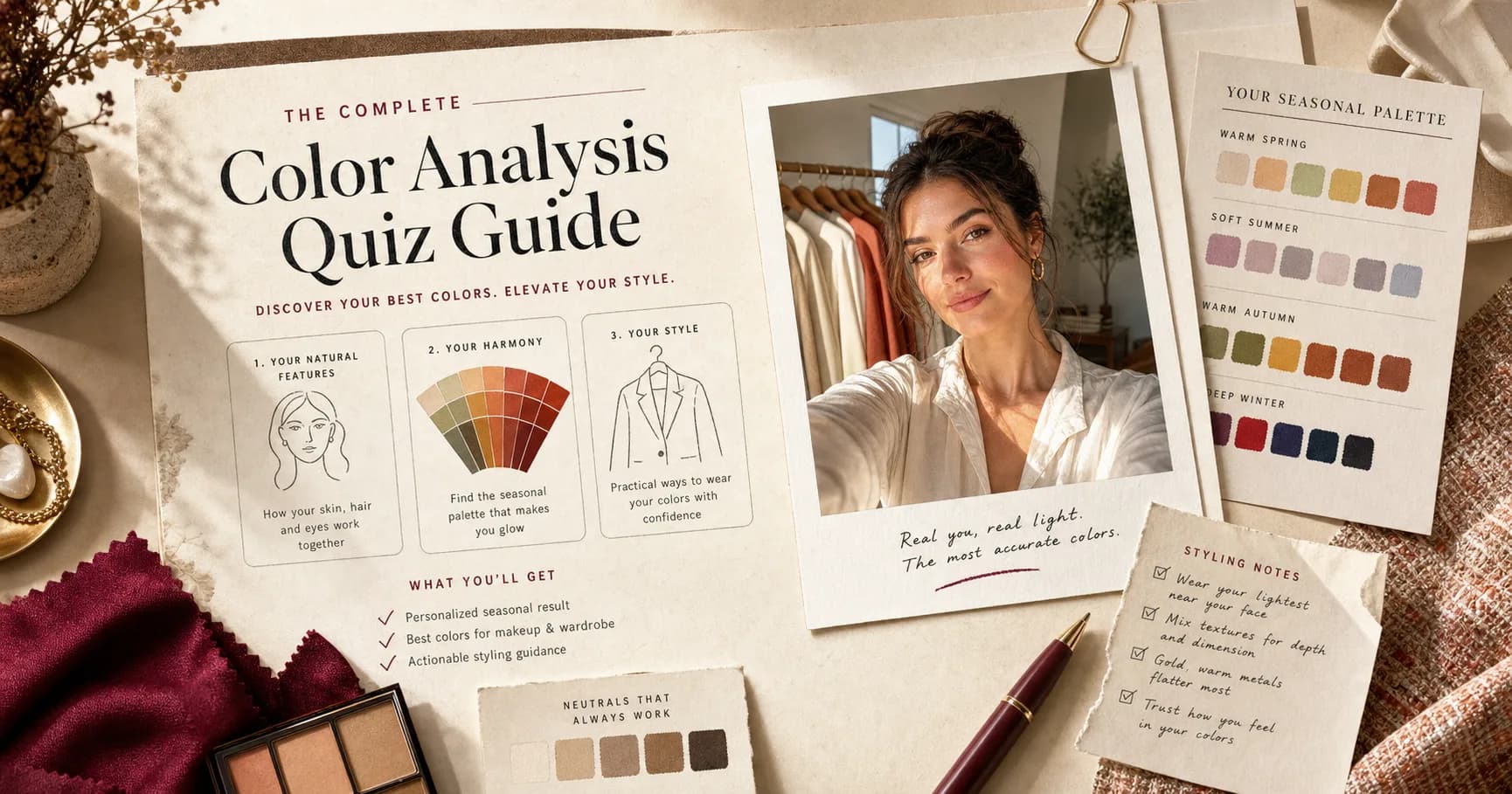
A color analysis quiz can point you toward a likely season, but it should not be treated as a final verdict. Most quizzes ask about hair color, eye color, undertone, contrast, and how you react to certain colors. Those clues help, but they depend on how well you can judge yourself.
StyleCard uses the same useful questions as a starting point, then checks your actual photo before it creates a free preview. That matters because many people are between seasons, have dyed hair, wear makeup, or look different in warm indoor light than they do near a window.
What a color analysis quiz can tell you
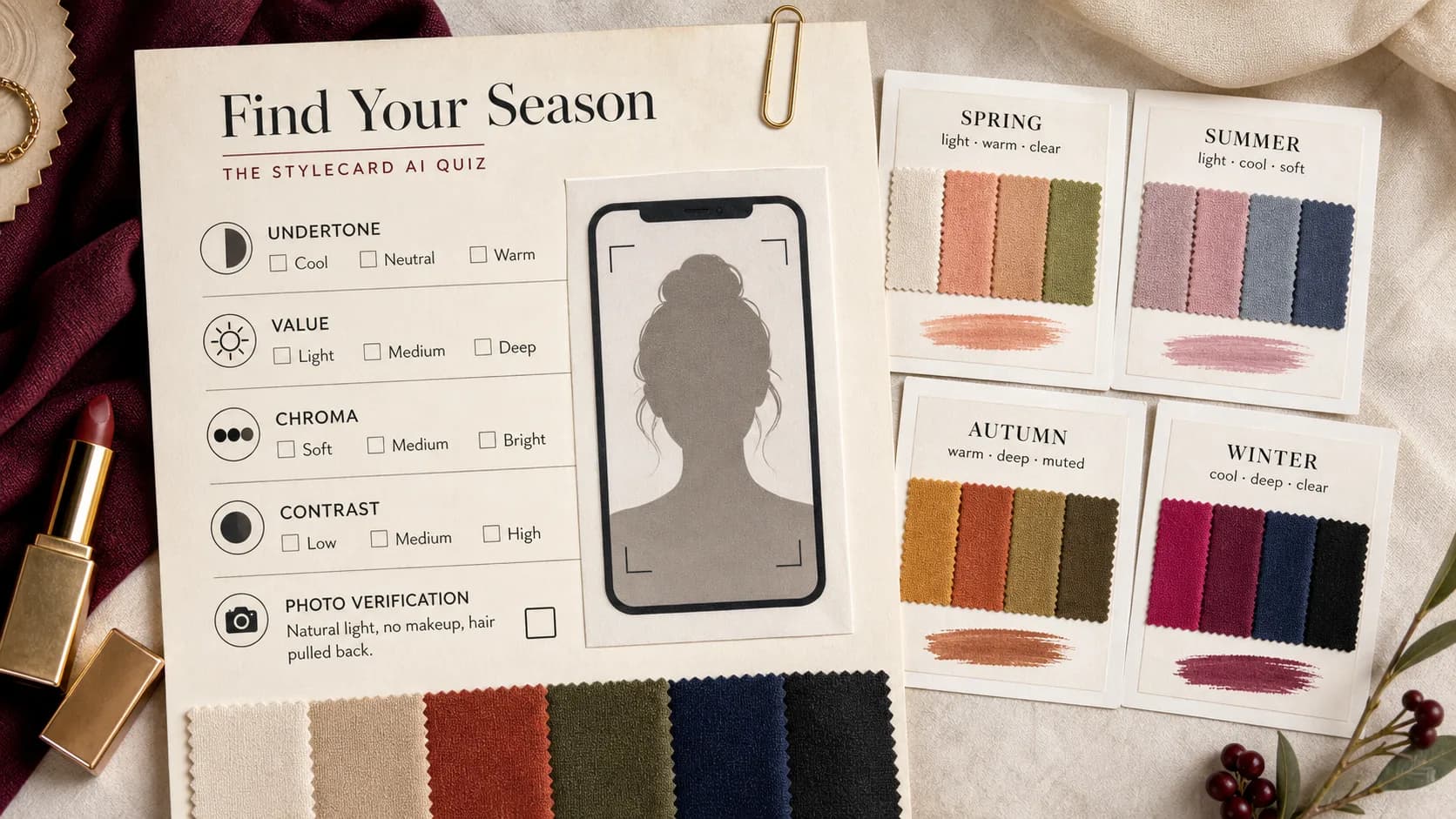
A useful quiz looks for three things: temperature, value, and chroma. Temperature asks whether you lean warm, cool, or neutral. Value asks whether lighter or deeper colors usually sit better near your face. Chroma asks whether clear bright colors or softer muted colors feel easier on you.
Those answers can place you near a seasonal family: spring, summer, autumn, or winter. More detailed systems split those into 12 seasons, such as light spring, soft autumn, true summer, and deep winter.
- Warm and bright answers often point toward spring.
- Cool and soft answers often point toward summer.
- Warm and muted answers often point toward autumn.
- Cool and high-contrast answers often point toward winter.
Good quiz questions vs weak quiz questions
A strong seasonal color analysis quiz asks about how colors behave on your face, not only what your features look like. Hair, eye, and skin labels can help, but they do not determine your season by themselves. The better question is whether coral beats blue-pink, charcoal beats camel, or dusty rose beats bright orange near your face.
Weak quizzes over-weight stereotypes. They may assume fair skin means Summer, deep skin means Autumn or Winter, blue eyes mean cool, or gold jewelry means warm. Those shortcuts miss neutral, olive, muted, bright, dyed-hair, and deeper-skin edge cases.
- Good: asks warm vs cool color reactions, light vs deep preferences, and soft vs bright tolerance.
- Good: asks whether hair is dyed and whether makeup or lighting may affect the answer.
- Weak: asks only hair color, eye color, vein color, and tanning behavior.
- Weak: gives one fixed season without uncertainty or colors to test.
Why quiz-only results go wrong
Quiz results break down when the questions ask you to self-diagnose subtle features. Most people can name their hair color. Fewer can judge whether their skin is cool olive, warm golden, neutral beige, or muted. Jewelry questions are also shaky because personal taste gets mixed into the answer.
Lighting makes the problem worse. A bathroom selfie can make skin look yellow. A cloudy outdoor photo can flatten contrast. Heavy makeup and beauty filters can hide the natural cues a quiz is trying to infer.
- You may answer based on colors you like, not colors that flatter you.
- Dyed hair can pull the quiz toward the wrong season.
- Many deeper skin tones are mistyped when a quiz treats depth as the main signal.
- Borderline seasons need comparison, not a single fixed answer.
A better quick self-check
Before you upload a selfie, do a simple check in natural window light. Pull your hair back if it is dyed, remove heavy lipstick or bronzer, and hold a few plain colors near your face. You are looking for what happens to your skin, eyes, and shadows, not whether you like the shirt.
If soft rose, slate blue, and cool taupe make your face look even, you may lean summer. If ivory, camel, olive, and warm brick look easier than stark white or black, autumn may be closer. If black, white, cobalt, and sharp pink look clean instead of harsh, winter is worth checking. If coral, clear turquoise, grass green, and cream wake up your face, spring may be in range.
Quiz vs photo analysis
A quiz is useful because it teaches the language of color analysis. You learn whether the issue is warmth, depth, brightness, or softness. A photo-based preview adds the missing evidence: how those ideas sit on your actual face.
Use the quiz result as a shortlist. If it points to Summer, test the Summer family. If it points to Autumn, compare Soft, Warm, and Deep Autumn. If it gives two possible seasons, that is not a failure; it is a sign to validate with a clean photo and real colors.
- Quiz strength: fast, free, educational, and good for narrowing choices.
- Quiz limit: depends on self-judgment and can miss mixed undertones.
- Photo strength: can read contrast and harmony more directly.
- Photo limit: depends on lighting, camera processing, makeup, and dyed hair.
Sample question categories that actually help
A better color analysis test asks about reactions, not labels. Instead of asking only whether your eyes are brown or blue, it should ask which color families make your face look clearer: coral or blue-pink, cream or optic white, camel or charcoal, olive or pine, dusty rose or orange, soft navy or black.
Good quizzes also ask whether your hair is dyed, whether you are wearing foundation or self-tanner, and whether you are answering from a mirror or a photo. Those context questions matter because a seasonal color analysis quiz is only as good as the evidence behind each answer.
- Temperature questions: Do peach, coral, camel, and gold look easier than rose, blue-red, charcoal, and silver?
- Value questions: Do light colors lift you, or do you need depth before your face looks balanced?
- Chroma questions: Do bright clear colors wake you up, or do muted grayed colors look more expensive and natural?
- Contrast questions: Does black-and-white contrast look sharp and clean, or does it overpower your face?
- Validation questions: Which two colors consistently make you look tired, yellow, gray, or shadowed?
How to use a free color analysis quiz without over-trusting it
Treat a free color analysis quiz as a hypothesis generator. If it says Soft Summer, your job is not to accept the label; it is to test whether low-chroma cool colors actually help. If it says Bright Spring, test whether clear warm color beats dusty color and icy Winter color in daylight.
The safest workflow is to take one seasonal color analysis quiz, write down the top two possible seasons, retake it with stricter assumptions, then test three best colors and three avoid colors near your face. If the result changes because one answer changed, that is useful information: your case probably needs photo validation or draping.
- Retake once without makeup, filters, or dyed-hair assumptions.
- Do not answer based on favorite colors or colors you wish worked.
- Compare real fabric, lipstick, and jewelry in indirect daylight.
- Use StyleCard when quiz results conflict or when you need practical wardrobe, makeup, and hair direction.
How StyleCard uses the quiz
StyleCard asks about style direction, occasion, age range, gender presentation, climate, and comfort with hair and makeup changes. The quiz keeps the result practical. A palette is more useful when it also tells you what to wear to work, what makeup direction to try, and which hair changes are realistic for you.
The free preview uses your selfie and answers together. The paid pack goes further with color, outfit, makeup, hair, and overview cards for $9.99.
Try it on your photo
Take the free StyleCard quiz
Start with a clear selfie and a short quiz. You will see a free preview before deciding whether the full pack is worth it.
Take the free StyleCard quizRelated StyleCard guides
FAQ
- How accurate is a color analysis quiz?
- A quiz can be useful for narrowing your likely season, but it is not exact. Accuracy depends on honest answers, good lighting, natural hair and makeup cues, and whether the quiz handles neutral or mixed features.
- Why do different quizzes give me different seasons?
- Different quizzes weigh clues differently. One may focus on jewelry and undertone, another may focus on contrast or hair color. If you are between seasons, small wording changes can move your result.
- Is selfie color analysis better than a quiz?
- A clear selfie can add useful visual context, especially for contrast and how colors sit against your face. It still depends on photo quality, so natural light and no heavy filters matter.
- What should a free color analysis quiz ask?
- It should ask about warm vs cool color reactions, light vs deep colors, soft vs bright colors, contrast, dyed hair, makeup, and colors that make your face look tired or clearer.
- Can a quiz tell me my exact 12-season palette?
- Sometimes, but it should be treated as a shortlist. Exact sub-season typing usually needs color comparisons or a clear photo because neighboring seasons can share many clues.
Sources
About the StyleCard Team
Our guides are written using established color analysis frameworks — including the seasonal color system and Munsell color theory — reviewed against practitioner and academic sources, and updated when research or product changes warrant a revision. See the Sources section above for the references used in this article.