
color analysis for dark skin
Color Analysis for Dark Skin
By the StyleCard Editorial Team · Last updated November 25, 2026
Rich melanin is not limited to Deep Autumn or Deep Winter. Map deep complexions across all 4 seasons, avoid chalky traps, and run a melanin-calibrated check.
Short answer
Dark skin tones belong to any seasonal family based on undertone (golden-warm vs plum-cool vs green-gray olive), chroma (vivid clarity vs smoky muting), and feature contrast rather than melanin depth alone. Test vivid cobalt vs warm terracotta and dusty berry vs coral before defaulting to dark neutrals.
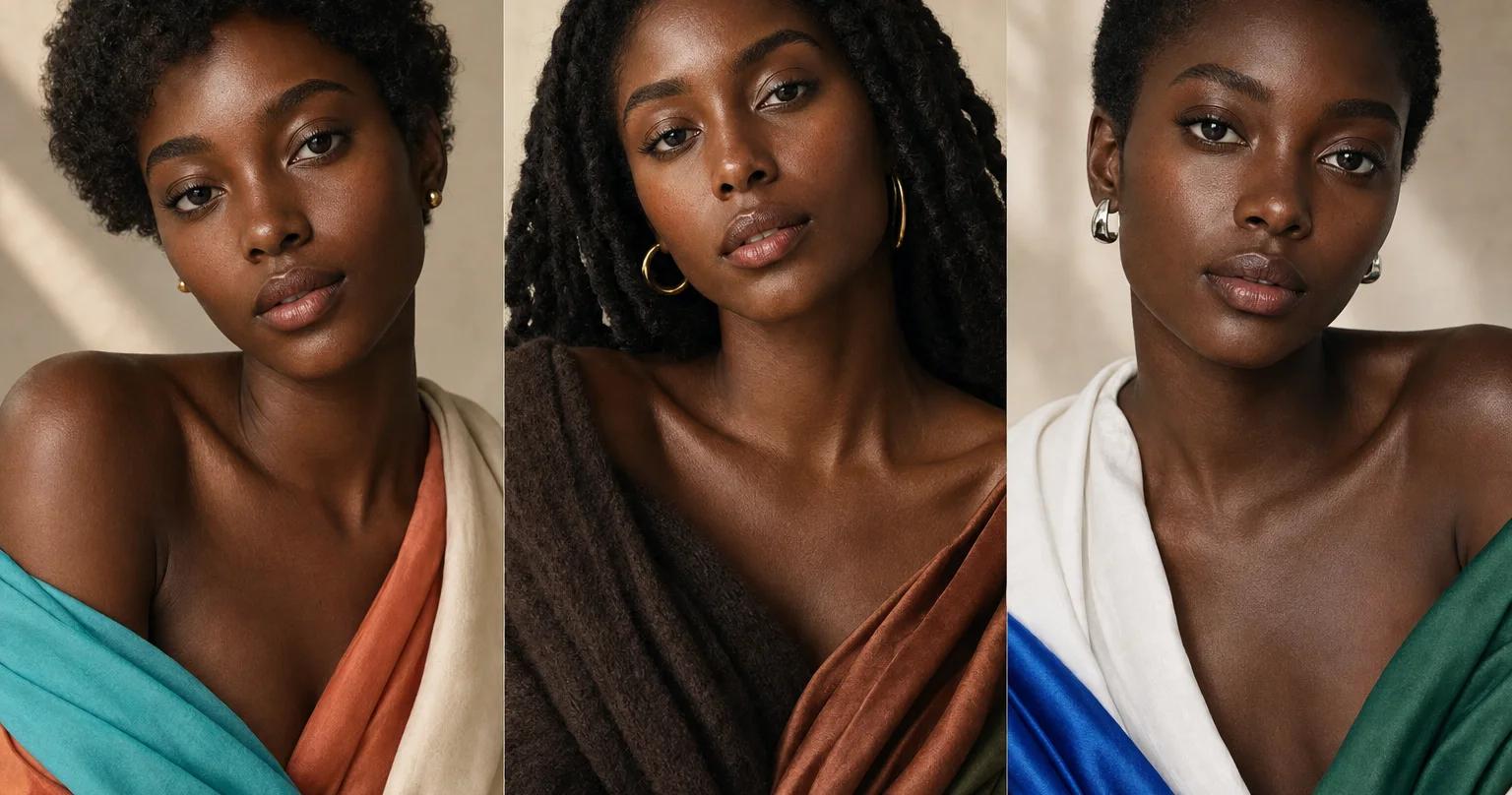
Legacy seasonal quizzes routinely shortcut deep brown skin and dark hair straight into Deep Autumn or Deep Winter. That habit confuses surface melanin depth with seasonal contrast: two women with nearly identical deep complexions can belong to completely opposite seasons depending on golden vs blue-plum undertone, sclera-to-skin contrast, and soft vs bright chroma.
Deep skin exists vibrantly across Bright Spring, Warm Spring, Soft Summer, Cool Summer, Warm Autumn, Deep Autumn, Bright Winter, and Deep Winter. Measure undertone, chroma, and contrast independently instead of letting skin depth pick your closet.
How dark skin maps across all 4 season families
Compare clear vibrant shades, smoky muted shades, golden earth tones, and icy jewel contrast to locate where rich melanin shines brightest.
As modern seasonal frameworks demonstrate, 'dark' in 12-season color theory refers to prominent shadow weight in a palette rather than skin color. Use the four-family matrix below to evaluate real colors near your collarbone:
| Season Family (Subtypes) | Undertone & Contrast Signal | Core Neutrals | Signature Power Colors | Blush, Lip & Metal Winners |
|---|---|---|---|---|
| Spring (Warm & Bright Spring) | Golden-amber glow, bright eyes/sclera clarity, sunlit warmth | Warm ivory, camel, golden chocolate, warm navy | Mango, vivid coral, clear turquoise, apple green | Apricot blush, juicy coral or poppy lip; glossy yellow gold |
| Summer (Soft & Cool Summer) | Neutral-cool or muted plum-gray base, soft blended facial contrast | Soft charcoal, pewter gray, cool espresso-taupe, soft navy | Dusty rose, muted teal, soft berry, lavender-slate | Cool rosewood or mauve lip, berry blush; brushed silver or pewter |
| Autumn (Warm & Deep Autumn) | Golden, bronze, or olive-warm glow; rich grounded contrast | Almond cream, espresso, mahogany, dark olive | Terracotta, paprika rust, marigold, deep peacock, forest | Spiced brick, dark terracotta, cinnamon nude; antique gold & brass |
| Winter (Deep, Cool & Bright Winter) | Cool blue-red or deep plum undertone; sharp sclera/feature contrast | Optic white, jet black, granite, inky navy | Cobalt blue, emerald, crimson blue-red, fuchsia, icy cyan | Lacquered crimson, cool damson, fuchsia; mirror silver & platinum |
5 common mistyping traps on deep melanin skin tones
Wrist veins, dim indoor bulbs, chalky pastel comparison drapes, and hyperpigmentation shadow routinely distort undertone checks on rich melanin.
Fix these five mechanical errors before trusting any online quiz or beauty-counter match:
| Mistyping Trap | Why It Misleads | Calibrated Correction |
|---|---|---|
| Depth-only quiz bias | Quizzes treat dark skin + dark hair = Deep Autumn/Winter as an automatic rule | Score chroma and temperature first: test Bright Spring coral vs Soft Summer berry |
| Chalky gray-white pastels | Milky pastels look ashy on bright or warm deep skin, mimicking a Winter conflict | Compare saturated warm apricot or icy winter tints instead of dusty beige |
| Perioral hyperpigmentation or ash | Uneven tone around mouth/forehead masks real cheek/chest undertone | Judge color harmony at the upper cheek, collarbone, and inner eyes |
| Dim indoor or warm bulb light | Low light flattens melanin saturation and biases photos falsely toward Autumn | Stand directly beside a bright indirect window with lamps off |
| Assuming everyone needs high-contrast black | Low-contrast deep skin looks severed behind stark black & white collars | Compare charcoal, soft navy, and espresso against stark jet black |
4-step daylight self-check calibrated for rich melanin
Use bright indirect daylight and vivid-vs-muted pairs rather than pale pastels or wrist veins.
- 1. Set bright indirect window lighting (zero dim bulbs): Turn off overhead warm lamps and face an open bright window in mid-morning. Keep lip balm clear and bare neck/collarbone visible.
- 2. Test jewel cool vs spiced warm drapes: Alternate electric cobalt and crimson blue-red against rich terracotta and marigold yellow under your chin. Watch whether your eyes look brighter and skin looks uniform.
- 3. Check high-chroma crisp vs smoky-muted contrast: Compare stark optic white + cobalt against smoky charcoal + muted dusty teal or olive. If softer blends let your features lead, explore Soft Summer or Soft Autumn.
- 4. Confirm blush/lip + metal finish on StyleCard: Compare cool berry against coral-bronze blush alongside equal-shine silver vs bronze jewelry, then run a bright window-light selfie in StyleCard.
Bottom line: Ignore 'dark hair equals Winter/Autumn' stereotypes: let vivid cobalt vs marigold and smoky muted vs crisp white decide your exact season across bright daylight.
Try it on your photo
Analyze your deep-skin palette with StyleCard
Upload a bright window-light selfie to check whether Spring, Summer, Autumn, or Winter unlocks your clearest glow.
Analyze your deep-skin palette with StyleCardRelated StyleCard guides
FAQ
- Can dark skin tones be Spring or Summer color seasons?
- Yes. Undertone, chroma, and facial contrast operate independently of melanin depth. Deep skin with clear golden warmth thrives in Warm or Bright Spring; deep skin with cool, blended low contrast glows in Soft or Cool Summer.
- Why do pastels sometimes look ashy on dark skin?
- Powdery, chalky pastels contain heavy white/gray pigment that clashes when a complexion needs saturation or warmth. Switching to saturated coral, bright turquoise, espresso, or crisp icy jewel tints removes ashiness.
- Can dark skin have an olive undertone?
- Yes. Deep olive skin shows a subtle green-gray cast alongside rich brown depth, explaining why both standard peach and bright pink foundations look wrong while olive-neutral bases vanish.
- Does dark skin always look best in gold jewelry?
- No. Gold glows on warm-toned deep skin, whereas cool-toned Deep, Cool, or Bright Winter deep skin looks remarkably crisp in platinum, white gold, and polished silver.
- How do I take an accurate selfie on deep skin for AI color analysis?
- Face a bright indirect daylight window (never dim shade or warm indoor bulbs), turn off camera beauty smoothing, and wear a plain neutral top so ambient shadows do not flatten your undertone.
Sources
About the StyleCard Editorial Team
Our guides are written by the StyleCard Editorial Team using established color analysis frameworks, including the 12-season system and Munsell color dimensions (hue, value, and chroma), cross-checked against practitioner and reference sources and updated whenever research or product features change. Read our full methodology and editorial standards. See the Sources section above for the references cited in this guide.