
lipstick colors by season
Lipstick Colors by Season
By the StyleCard Team · Last updated July 3, 2026
Choose lipstick by color season, undertone, depth, and finish with practical red, nude, pink, berry, coral, and brown shade guidance.
Short answer
Spring usually suits coral, peach, warm pink, and strawberry red. Summer suits rose, mauve, soft berry, and raspberry. Autumn suits terracotta, brick, cinnamon, and brown-red. Winter suits blue-red, fuchsia, plum, and deep berry.
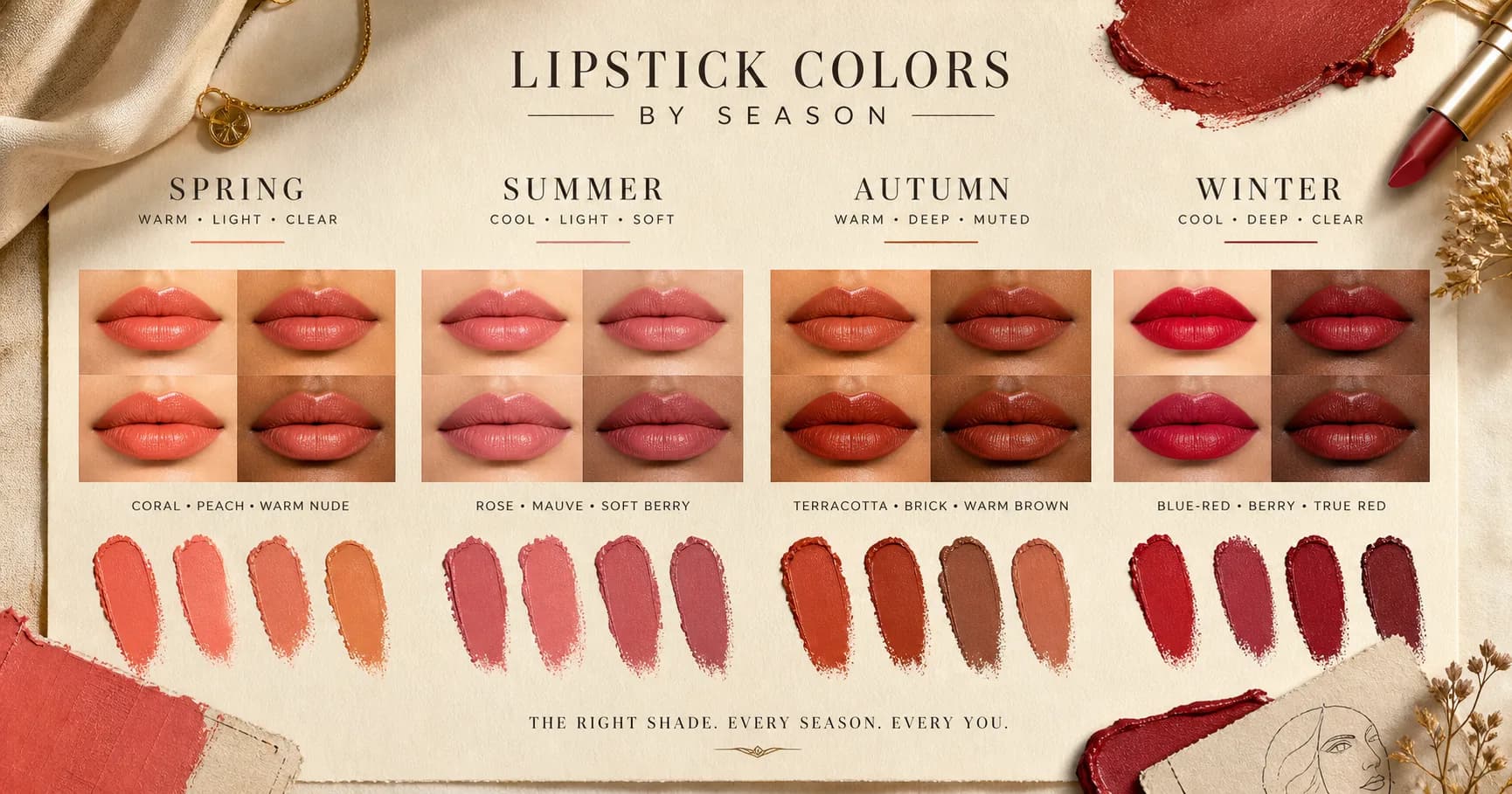
Lipstick is one of the fastest ways to test a color season because it sits directly on the face. The right undertone makes teeth, skin, and eyes look clearer. The wrong undertone can make the same face look gray, yellow, tired, or separate from the makeup.
Use season guidance as a buying filter, not a rigid rule. Your natural lip pigment, skin depth, contrast, makeup style, and finish preference all affect how a shade wears.
Start with temperature, then intensity
A red lipstick can be warm, cool, clear, muted, light, or deep. Blue-based reds lean cooler and often suit Winter or Summer. Orange-based reds lean warmer and often suit Spring or Autumn. The same logic applies to pink, nude, coral, berry, and brown families.
After temperature, check intensity. Soft seasons usually need lower saturation and a diffused finish. Bright seasons can handle cleaner color. Deep seasons need enough depth. Light seasons need color that lifts without overwhelming.
- Cool red: cherry, blue-red, cranberry, raspberry.
- Warm red: poppy, tomato, brick, orange-red.
- Muted lip: rose, mauve, dusty berry, cinnamon.
- Bright lip: coral, fuchsia, clear pink, lacquered red.
Spring lipstick colors
Spring lips work when the color feels warm, fresh, and alive. Coral, peachy pink, warm rose, strawberry red, salmon, poppy, and light tomato red often look easier than dusty mauve or blue-based berry.
Finish helps. Spring usually benefits from satin, gloss, balm, or a fresh cream finish because too much matte weight can dull the face. Bright Spring can take a stronger poppy or warm fuchsia, while Light Spring usually needs softer peach and pink.
Summer lipstick colors
Summer lips are cool and softened. Look for rose, mauve, dusty pink, soft berry, raspberry, faded cranberry, plum-rose, and cool pink nude. Orange-coral and brown-orange lipstick often fight the palette.
Soft Summer usually needs muted mauve, dusty rose, and gentle plum. Cool Summer can go cleaner and cooler with rose, berry, and blue-pink. Light Summer does best when shades stay fresh and not too dark.
Autumn lipstick colors
Autumn lipstick is warm, earthy, and dimensional. Terracotta, brick, cinnamon, pumpkin, warm rose-brown, clay, caramel nude, and brown-red usually sit more naturally than icy pink or blue-red.
Cream, velvet, satin, and soft matte finishes can all work because they echo the palette's texture. Soft Autumn needs a gentler warm rose or muted terracotta. Warm Autumn can wear richer spice colors. Deep Autumn can take espresso, raisin-brown, and dark brick.
Winter lipstick colors
Winter lipstick is cool, clear, and higher contrast. Blue-red, cherry, scarlet, fuchsia, raspberry, plum, wine, deep berry, and cool rose can look clean instead of loud on Winter coloring.
Bright Winter can handle electric pink and lacquered red. Cool Winter suits blue-red, cool rose, and crisp berry. Deep Winter needs depth: plum, burgundy, deep berry, and cool red-brown. Warm nude, beige, and orange lipstick often look disconnected.
Nude lipstick is not one color
Nude lipstick should mean your natural lip enhanced, not beige. Fair lips may need pinky nude, peach nude, or rose beige. Medium skin may need caramel, mauve, rose-brown, or warm tan. Deep skin may need cocoa, terracotta, berry-brown, espresso rose, or rich plum-brown.
Your lip pigmentation changes the result. A shade that looks peach in the tube can turn gray or bright pink on the mouth. Test lipstick on lips when possible, and compare it with blush so the undertones do not fight.
Lipstick family matrix
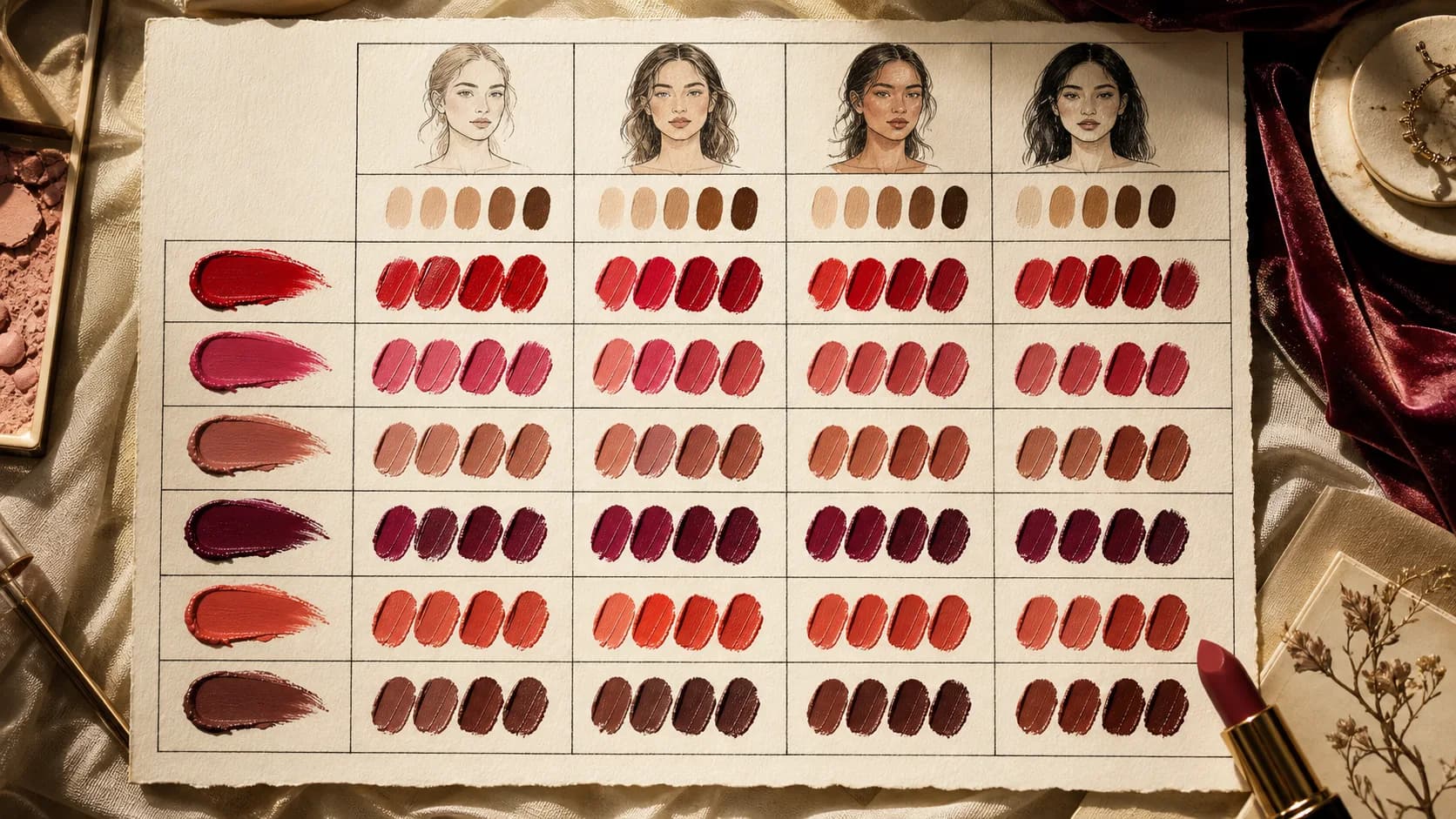
Use lipstick families as a matrix instead of shopping by shade name. The same word can mean different things across brands. A berry can be cool raspberry, dusty mauve-berry, warm raisin, or deep plum. A nude can be peach, rose, caramel, cocoa, mauve, or brown.
The season filter keeps you from buying the wrong version of a color you love. If you want red, find your red. If you want nude, find your nude. If you want pink, decide whether it should be peach-pink, rose-pink, warm watermelon, cool fuchsia, or muted mauve.
- Red: Spring coral-red or poppy; Summer raspberry-red or faded cranberry; Autumn brick or tomato-brown; Winter blue-red or scarlet.
- Pink: Spring peachy pink or watermelon; Summer rose and mauve; Autumn warm rose or clay pink; Winter fuchsia, hot pink, or cool rose.
- Nude: Spring peach nude; Summer cool pink nude; Autumn caramel, tan, or terracotta nude; Winter mauve, rose-brown, or deep plum-brown.
- Berry: Spring strawberry or warm raspberry; Summer soft berry; Autumn raisin-brown; Winter plum, wine, and deep berry.
- Coral and brown: coral is usually Spring or warm Autumn; brown is usually Autumn unless it is a cool espresso or plum-brown for deep Winter.
Red and nude lipstick decision guide
For red lipstick, choose the base first. Cool seasons usually need blue-red, cherry, cranberry, raspberry, or cool scarlet. Warm seasons usually need coral-red, tomato, brick, warm rose-red, or brown-red. Neutral seasons can sometimes wear true red, but the finish and depth still matter.
For nude lipstick, choose your lip-enhancing color rather than your skin color. A nude should add shape and harmony, not erase the mouth. On fair skin that might be pink beige or peach. On medium skin it might be caramel, rose-brown, or mauve. On deep skin it might be cocoa, berry-brown, terracotta, espresso rose, or plum-brown.
- Cool undertone red: blue-red, cherry, cranberry, raspberry.
- Warm undertone red: tomato, coral-red, brick, cinnamon.
- Soft season nude: rose, mauve, muted peach, warm rose-brown.
- Deep season nude: cocoa, espresso rose, berry-brown, plum-brown.
- Bright season lip: cleaner edges, more saturation, and deliberate contrast.
Lipstick Colors by Season evidence checklist
Lipstick Colors by Season should be judged by repeated evidence, not by one attractive swatch, one selfie, or one quiz answer. The strongest signal is consistency: the same color direction should make the face look clearer in daylight, make makeup easier, and make outfits feel more coherent.
Use this page with related guides such as makeup colors for your season, skin color analysis, seasonal color analysis, spring color palette. Cross-linking the evidence matters because color analysis is not just one category. A palette affects wardrobe neutrals, lipstick, hair color, metals, denim, and how much contrast an outfit can carry near the face.
For this topic, start with the practical test that matches the search intent: compare methods, check privacy and photo quality, then verify the result with real clothing, lipstick, jewelry, or consultant questions.
- Run the test in indirect daylight rather than warm bathroom light or golden hour.
- Remove strong lipstick, bronzer, filters, and saturated clothing when judging undertone.
- Compare neighboring possibilities directly instead of asking whether one label feels perfect.
- Keep notes on skin clarity, eye brightness, shadow, redness, and whether the color or your face gets attention.
- Use StyleCard as a photo-based preview, then keep only the guidance that survives real-world checks.
Lipstick Colors by Season practical next steps
After reading a guide like this, the next step should be small and testable. Do not replace a wardrobe, book a major salon change, or buy several products because one label sounded right. Start with one near-face color, one neutral, one metal, and one makeup cue.
If you are comparing tools, begin with the lowest-risk method that gives useful evidence. A free preview or quiz can narrow the field; a kit or consultant can resolve close calls; a paid report is most useful when it adds practical shopping, makeup, hair, and outfit guidance.
The most trustworthy result is flexible but not vague. It should say what to try, what to avoid, why the result might be uncertain, and how to confirm it. That is especially important for olive undertones, neutral coloring, deeper skin, dyed hair, gray hair, very muted palettes, and high-contrast palettes. If a recommendation cannot explain the tradeoff it is making, test again before spending money. A result should make repeat decisions easier, not just add a label.
- First purchase to test: one top, scarf, or lipstick in the likely palette.
- First closet move: move best colors near the face and weaker colors below the waist.
- First beauty move: test blush or lipstick before changing foundation or hair.
- First hair move: ask for a gloss, toner, or small shift before a dramatic multi-level change.
- First verification move: retake a clean photo and compare the result against real fabric.
- Final check: the guidance should improve at least three real choices, such as a neutral, a lip color, and a face-framing outfit.
Common lipstick mistakes
The most common lipstick mistake is choosing the right depth but the wrong undertone. A medium nude can still be too orange for a Summer. A deep red can still be too brown for a Winter. A bright pink can still be too blue for a Spring.
Another mistake is ignoring lip pigmentation. Naturally pigmented lips can deepen, cool, or mute a lipstick. If a shade disappears, turns gray, or looks much brighter than expected, use a liner close to your natural lip, blot the first layer, or try the same color family one level deeper.
- Spring mistake: frosty blue-pink, gray mauve, or muddy brown.
- Summer mistake: orange coral, beige-orange nude, or high-gloss neon red.
- Autumn mistake: icy pink, blue-red, or cool fuchsia.
- Winter mistake: terracotta, warm beige, dusty brown, or low-contrast nude with no definition.
- All seasons: test lipstick with blush so the undertones do not clash.
Try it on your photo
Get lipstick direction in your StyleCard
Upload a selfie and get a free preview. The full Style Card Pack includes a makeup direction card for lips, cheeks, eyes, and complexion.
Get lipstick direction in your StyleCardRelated StyleCard guides
FAQ
- What lipstick color suits my season?
- Match the lipstick's temperature and intensity to your season: warm and fresh for Spring, cool and soft for Summer, warm and earthy for Autumn, and cool and clear for Winter.
- What red lipstick is best for cool undertones?
- Blue-red, cherry, raspberry, cranberry, and cool scarlet are usually easier than tomato or orange-red.
- What is nude lipstick for deep skin?
- It can be cocoa, terracotta, rich rose-brown, berry-brown, espresso rose, or plum-brown. Nude means enhanced natural lip color, not beige.
- Should Summers avoid coral lipstick?
- Most Summers should be careful with orange-coral because it can look too warm. A cooler pink-coral may work for some Light Summers, but rose and mauve are safer.
- What lipstick finish fits each season?
- Spring often likes fresh gloss or satin, Summer soft cream or satin, Autumn cream or velvet matte, and Winter crisp matte or high shine.
Sources
About the StyleCard Team
Our guides are written using established color analysis frameworks — including the seasonal color system and Munsell color theory — reviewed against practitioner and academic sources, and updated when research or product changes warrant a revision. See the Sources section above for the references used in this article.