
hair color analysis
Hair Color Analysis
By the StyleCard Team · Last updated July 3, 2026
Use undertone, contrast, maintenance, and seasonal color direction to narrow down hair colors that are more likely to suit you.
Short answer
The best hair color usually works with your undertone and contrast instead of fighting them. Warm palettes tend to handle golden, copper, caramel, or auburn notes. Cool palettes tend to handle ash, beige, espresso, cool brown, or blue-red notes better.
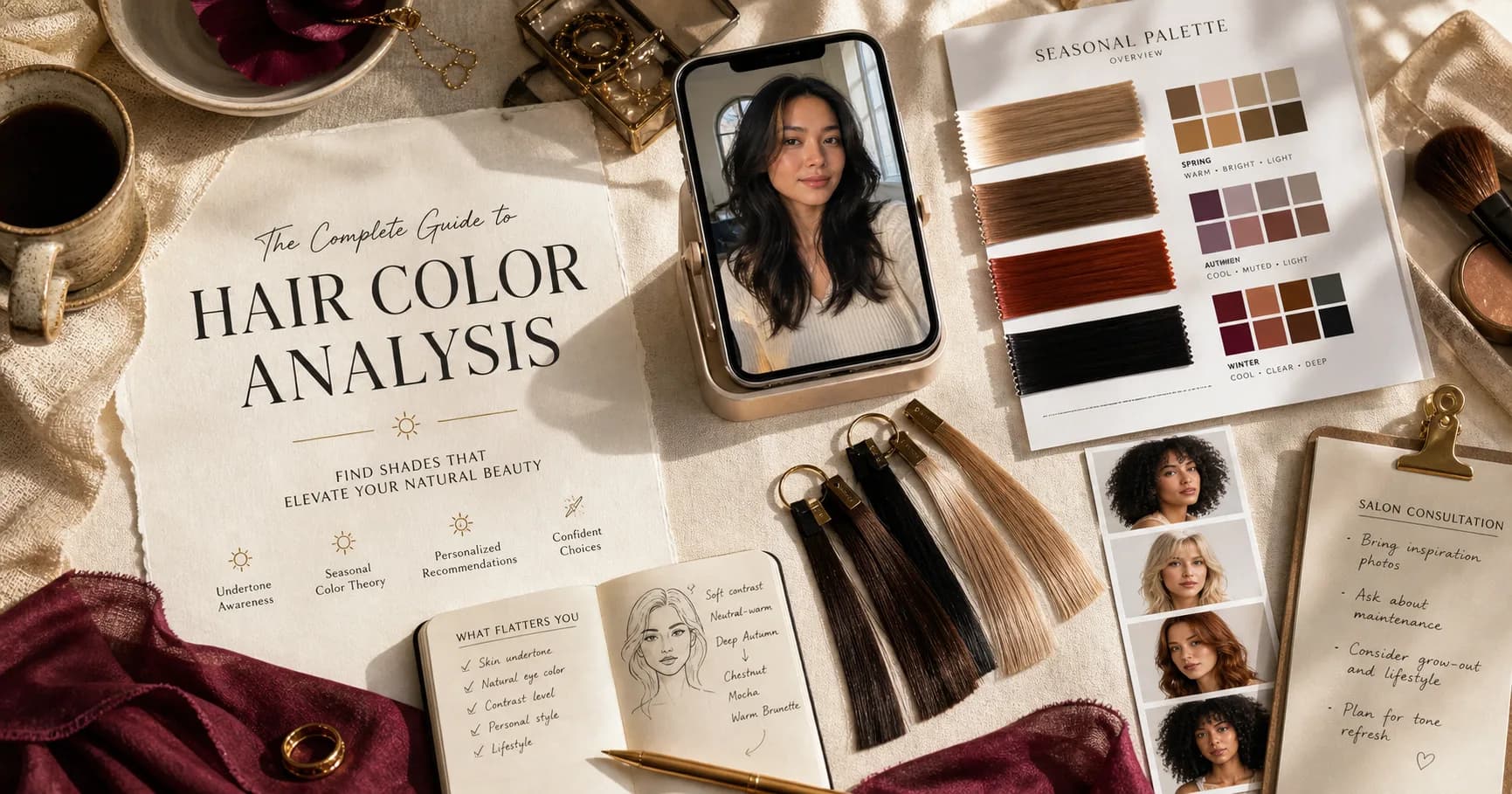
Hair color analysis is color analysis with higher stakes. A shirt can go back in the closet. Hair color costs money, grows out slowly, and changes the way your makeup and wardrobe read.
The safest approach is to match the color change to your undertone, contrast, natural depth, and maintenance comfort. A good result should also say when not to make a dramatic change.
How undertone affects hair color
Warm undertones often look more natural with golden blonde, honey, copper, auburn, caramel, chestnut, or warm brunette. Cool undertones often look cleaner with ash brown, cool beige blonde, espresso, blue-black, soft mushroom brown, or cool rose-brown.
Neutral undertones have more room, but contrast still matters. A low-contrast person may look better with blended color and soft dimension. A high-contrast person can often handle a sharper shift.
Do not match hair color to a temporary tan, a filtered selfie, or a foundation shade. Match it to the pattern that remains across bare skin, eyes, natural roots, contrast, and the colors that make your face look clear in daylight.
- Warm direction: honey blonde, golden brown, caramel, copper, auburn, chestnut.
- Cool direction: ash blonde, beige blonde, mushroom brown, cool brunette, espresso, blue-red, plum.
- Neutral direction: balanced bronde, soft brown, rose brown, mixed balayage, dimensional highlights.
- Olive direction: test both muted warm and muted cool shades before committing.
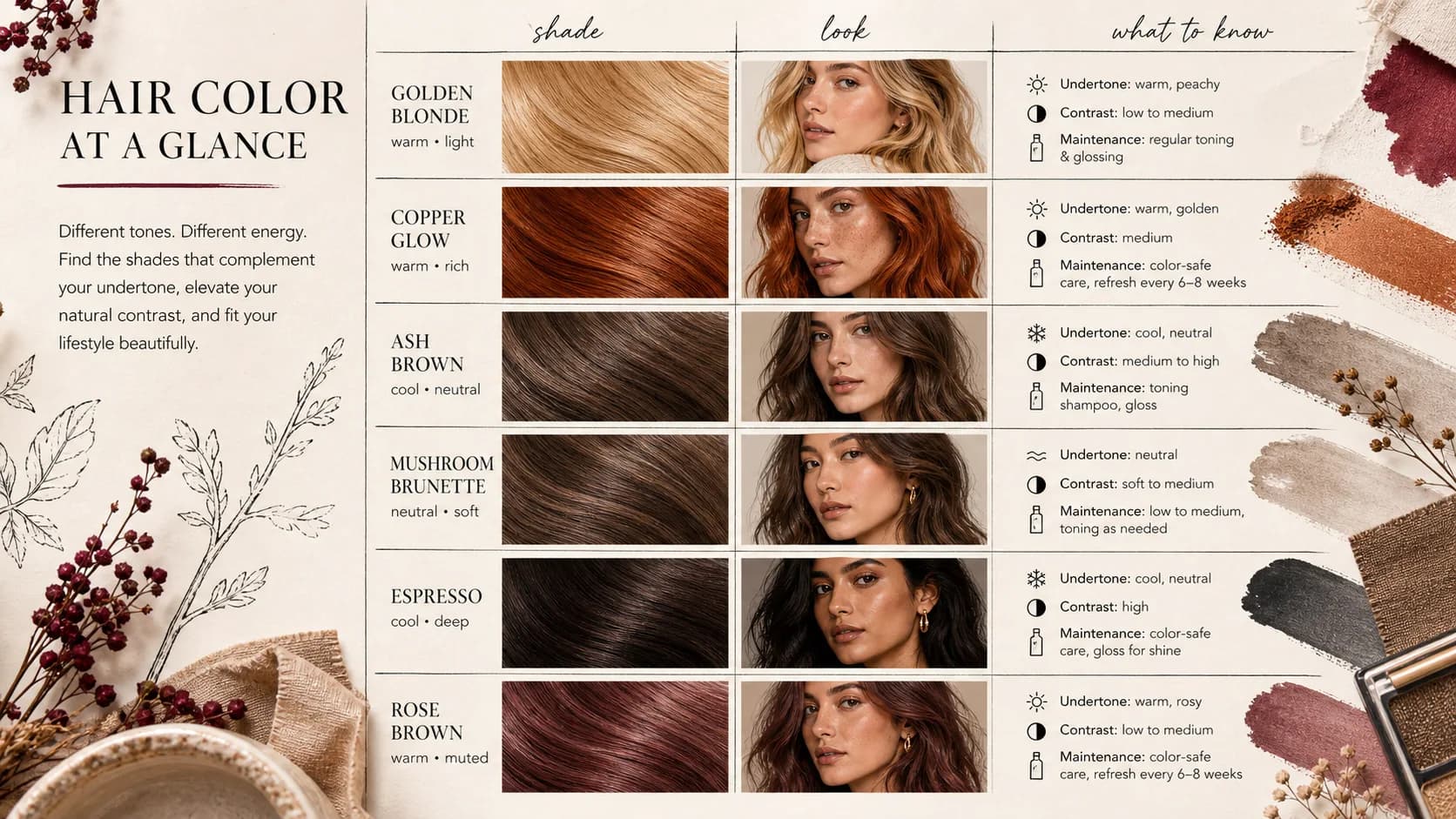
Hair color by seasonal color analysis
Seasonal color analysis helps because it gives more direction than warm vs cool. Spring usually needs warmth plus freshness. Summer usually needs coolness plus softness. Autumn usually needs warmth plus earthiness. Winter usually needs coolness plus clarity and contrast.
Use these as guardrails, not commands. Hair condition, natural base, brows, texture, budget, and maintenance should still shape the final formula.
- Spring: golden blonde, honey, strawberry blonde, warm light brown, soft copper, clear warm highlights.
- Summer: ash blonde, beige blonde, mushroom brunette, cool light brown, dusty rose-brown, soft lowlights.
- Autumn: auburn, chestnut, copper, caramel, golden brown, warm espresso, rich brown dimension.
- Winter: cool dark brown, espresso, blue-black, black-brown, cool burgundy, clean silver, icy accents when contrast supports them.
Natural-looking vs statement changes
Natural-looking changes usually stay close to your current depth and adjust temperature. Think soft beige instead of yellow blonde, cool espresso instead of flat black, or muted copper instead of bright orange.
Statement changes can work, but they need a different filter. Ask whether the color supports your face or becomes the only thing people see. Bright copper, icy platinum, blue-black, vivid red, and pastel fashion colors all need more commitment.
- If your palette is soft, avoid hair color that is much brighter than your face can support.
- If your palette is clear, avoid muddy color that makes your features look dull.
- If your palette is warm, be careful with smoky ash tones.
- If your palette is cool, be careful with orange, yellow, and brassy warmth.
Why StyleCard asks about hair-change comfort
Two people can have the same palette and need different advice. One may want the smallest salon-safe adjustment. Another may want a visible transformation. StyleCard asks how open you are to hair changes so the recommendation fits your real life.
The full Style Card Pack includes a hair direction card alongside color, outfit, makeup, and overview cards. That keeps the hair advice connected to the rest of your style instead of treating it like a separate trend decision.
Gray coverage and gray blending are a good example. As hair turns gray or silver, your overall contrast can soften or cool down. Some people need cooler toner, some need warmer lowlights, and some need wardrobe colors to soften. The right answer depends on the whole palette, not age.
Hair color families by undertone
The fastest salon filter is undertone. Warm undertones usually need hair color with gold, copper, peach, caramel, or red-brown warmth. Cool undertones usually need ash, beige, blue-violet, espresso, burgundy, or mushroom softness. Neutral undertones can often blend warm and cool dimension, but extremes still matter.
Olive undertones deserve extra care because surface green or gold can trick both people and cameras. Some olive clients look best in muted neutral browns, soft espresso, cool beige, muted auburn, or dimensional bronde rather than obvious yellow blonde or flat blue-black.
- Warm undertone: golden blonde, honey, caramel, copper, strawberry, chestnut, warm brunette.
- Cool undertone: ash blonde, beige blonde, mushroom brown, cool brunette, espresso, burgundy, blue-black.
- Neutral undertone: soft brown, bronde, rose brown, mixed balayage, balanced highlights and lowlights.
- Olive undertone: muted neutral brunette, cool beige, soft espresso, smoky caramel, or carefully tested auburn.
- Avoid extremes first: icy platinum, orange copper, box black, or yellow blonde should be tested before committing.
Value, chroma, and contrast in hair color
Hair color can change perceived contrast more than clothing does because it frames the face all day. Going much darker can make a low-contrast person look washed out. Going much lighter can make a deep or high-contrast person look unfinished. Going much brighter can overwhelm a soft palette.
Value asks how light or dark the hair should be. Chroma asks whether the hair should be clear and vivid or muted and smoky. Contrast asks whether your face can carry a strong difference between skin and hair. A Soft Summer and a Bright Winter can both be cool-toned, but they usually need very different hair effects.
- Low contrast: blended highlights, soft lowlights, gentle gloss, no harsh root line.
- High contrast: richer depth, clearer darks, sharper dimension, stronger brows if natural.
- Soft chroma: mushroom, ash beige, muted copper, soft chestnut, rose-brown, taupe brunette.
- Bright chroma: cleaner golden blonde, clear copper, glossy espresso, blue-black, vivid cool red when season supports it.
- Deep value: stay rich enough that makeup and wardrobe do not need to compensate.
Highlights, balayage, gray blending, and maintenance
Highlights can make a borderline color more wearable. A warm client may use golden face-framing pieces instead of all-over copper. A cool client may use ash or beige highlights to soften brunette hair. A neutral client may blend warm and cool ribbons so the result looks dimensional rather than one-note.
Gray hair often cools and softens the total look, but it does not erase undertone. Warm gray may need taupe, honey, or beige lowlights. Cool gray may need silver, ash, or violet-toned gloss to prevent yellowing. If you cover gray, match the new color to your palette and maintenance tolerance, not to the color you had at twenty.
Maintenance is part of accuracy. Copper, vivid red, platinum, and heavy blonde often require frequent toning. Dark box dye is hard to reverse. Full bleach can affect curl pattern and hair texture. A good color is one you can keep healthy.
- Low-maintenance route: gloss, demi-permanent color, soft balayage, or one-level tonal shift.
- High-maintenance route: vivid copper, icy blonde, black-to-blonde changes, or frequent gray coverage.
- Ask for a strand test before major lightening or color correction.
- Ask whether the formula will fade warmer, cooler, darker, or duller over time.
- Bring palette language to the salon: warm/cool, soft/bright, light/deep, low/high contrast.
Season-by-season salon direction
Bring season language to the salon in plain terms. Spring usually needs warm, fresh, light-to-medium color. Summer usually needs cool, soft, blended color. Autumn usually needs warm, earthy, dimensional color. Winter usually needs cool, clear, high-contrast color.
The exact formula still belongs to the colorist because hair condition, prior dye, porosity, texture, natural level, and maintenance all matter. Your season gives the guardrails; the salon plan turns them into a healthy result.
- Spring: golden blonde, strawberry, honey, copper, warm light brown, clean warm highlights.
- Summer: ash blonde, beige blonde, mushroom brown, cool brunette, soft lowlights, muted rose-brown.
- Autumn: caramel, copper, auburn, chestnut, mahogany, warm espresso, golden brunette.
- Winter: cool espresso, black-brown, blue-black, cool burgundy, silver, icy accents when contrast supports them.
- Ask your colorist how the shade will fade and how often it needs gloss, toner, or root work.
Hair Color Analysis evidence checklist
Hair Color Analysis should be judged by repeated evidence, not by one attractive swatch, one selfie, or one quiz answer. The strongest signal is consistency: the same color direction should make the face look clearer in daylight, make makeup easier, and make outfits feel more coherent.
Use this page with related guides such as what is color analysis, makeup colors for your season, skin color analysis, AI color analysis. Cross-linking the evidence matters because color analysis is not just one category. A palette affects wardrobe neutrals, lipstick, hair color, metals, denim, and how much contrast an outfit can carry near the face.
For this topic, start with the practical test that matches the search intent: compare methods, check privacy and photo quality, then verify the result with real clothing, lipstick, jewelry, or consultant questions.
- Run the test in indirect daylight rather than warm bathroom light or golden hour.
- Remove strong lipstick, bronzer, filters, and saturated clothing when judging undertone.
- Compare neighboring possibilities directly instead of asking whether one label feels perfect.
- Keep notes on skin clarity, eye brightness, shadow, redness, and whether the color or your face gets attention.
- Use StyleCard as a photo-based preview, then keep only the guidance that survives real-world checks.
Hair Color Analysis practical next steps
After reading a guide like this, the next step should be small and testable. Do not replace a wardrobe, book a major salon change, or buy several products because one label sounded right. Start with one near-face color, one neutral, one metal, and one makeup cue.
If you are comparing tools, begin with the lowest-risk method that gives useful evidence. A free preview or quiz can narrow the field; a kit or consultant can resolve close calls; a paid report is most useful when it adds practical shopping, makeup, hair, and outfit guidance.
The most trustworthy result is flexible but not vague. It should say what to try, what to avoid, why the result might be uncertain, and how to confirm it. That is especially important for olive undertones, neutral coloring, deeper skin, dyed hair, gray hair, very muted palettes, and high-contrast palettes. If a recommendation cannot explain the tradeoff it is making, test again before spending money. A result should make repeat decisions easier, not just add a label.
- First purchase to test: one top, scarf, or lipstick in the likely palette.
- First closet move: move best colors near the face and weaker colors below the waist.
- First beauty move: test blush or lipstick before changing foundation or hair.
- First hair move: ask for a gloss, toner, or small shift before a dramatic multi-level change.
- First verification move: retake a clean photo and compare the result against real fabric.
- Final check: the guidance should improve at least three real choices, such as a neutral, a lip color, and a face-framing outfit.
Before you book the appointment
Bring your stylist a direction instead of only a celebrity photo. Say whether you need warm or cool, soft or clear, light or deep, and low maintenance or statement. If you use StyleCard first, bring the hair card and color story to the consultation.
Use a current selfie in natural light for your preview. Dyed hair can affect the read, so pull it back if you want the analysis to focus more on skin, eyes, and contrast.
Ask practical salon questions before the color goes on your hair. The best shade is not helpful if it requires maintenance you will not keep or if it damages your texture in one appointment.
- What is my natural level and underlying pigment?
- Will this shade make my brows or lashes look disconnected?
- How many sessions would this take without damaging my hair?
- What toner, gloss, or lowlight keeps this warm or cool enough?
- How often will I need roots, gloss, purple shampoo, or color-safe care?
Try it on your photo
Get hair color direction in your style card
Try a free StyleCard preview before you spend salon money. The full $9.99 pack includes a hair direction card.
Get hair color direction in your style cardRelated StyleCard guides
FAQ
- Can color analysis help choose hair color?
- Yes. It can narrow warm vs cool, soft vs bright, and light vs deep hair directions. A stylist still needs to account for hair condition, current color, and maintenance.
- Should I match my hair color to my season exactly?
- No. Use your season as a guardrail. The best salon result also considers your natural base, texture, budget, and how often you want to maintain it.
- Can dyed hair affect my analysis?
- Yes. Strongly dyed hair can pull an analysis in the wrong direction. For a cleaner read, pull dyed hair back and use natural light.
- What is the best hair color for me?
- The best hair color is usually close enough to your natural depth to look believable, warm or cool enough for your undertone, and bright or muted enough for your contrast and chroma.
- How does gray hair affect color analysis?
- Gray hair can cool or soften your overall coloring, but it does not erase undertone. You may need adjusted hair, makeup, and wardrobe contrast as the gray becomes a larger part of your look.
Sources
About the StyleCard Team
Our guides are written using established color analysis frameworks — including the seasonal color system and Munsell color theory — reviewed against practitioner and academic sources, and updated when research or product changes warrant a revision. See the Sources section above for the references used in this article.